
Binatone TV Master MK 6
The Binatone TV Master MK 6 brought shooting games and a light gun into my living room in 1978. Connected to my little black and white portable TV, it felt futuristic — until curiosity got the better of me and I broke the gun taking it apart.

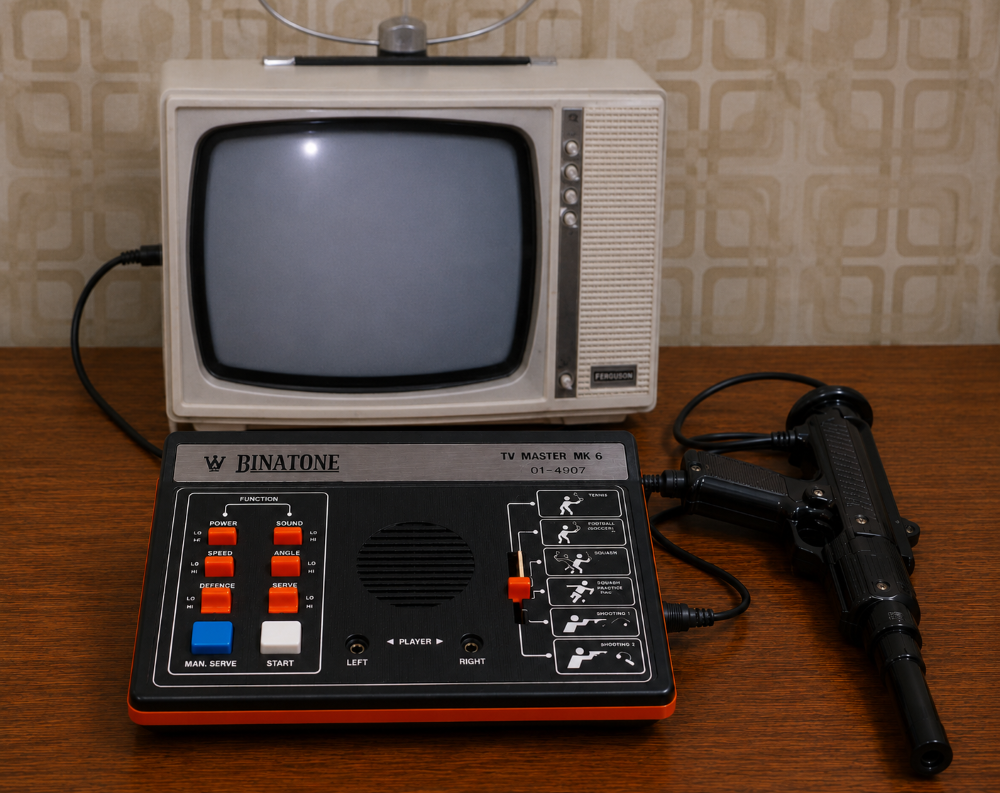
Sometime around the late 1977, while wandering around the shops in my local town, I spotted another Binatone games console sitting in a shop window. It was the Binatone TV Master MK 6, an updated version of the earlier MK IV I’d owned before. This new one looked far more exciting because it now had six games instead of four, and more importantly, it came with a futuristic-looking “light gun.”
That alone was enough to make me want it.
I can’t remember exactly how much it cost, but I knew I had to have it. In the late 1970s anything electronic that connected to a television still felt modern and slightly magical, and the idea of owning a console with a gun controller made it feel like something from the future.
Like the earlier TV Master machines, the MK 6 was still part of the huge wave of Pong-style consoles that flooded the UK market in the second half of the 1970s. Binatone had become one of the best-known names in Britain for these systems because they were affordable, simple to use, and appeared in almost every catalogue and electrical shop. By then there were dozens of similar machines from different manufacturers, most powered by variations of the General Instruments AY-3-8500 series chips that handled the entire game logic on a single integrated circuit.
The four standard games were basically the same as the ones on the previous machine:
- Tennis — the classic Pong-style game with two bats and a bouncing square ball.
- Football — with extra bats acting as goalkeepers.
- Squash — both players hitting against the same wall.
- Squash Practice — a single-player version.
But the big selling point was the addition of the shooting games and the light gun.
Compared to the earlier console, this suddenly felt far more advanced. Instead of just turning knobs and batting a white square around the screen, you could now point a gun at the television and “shoot” targets. In reality the targets were usually little more than moving white dots or blocks, but at the time it felt incredible.
I spent hours playing the shooting games.
The way it worked seemed almost magical then. A dot would move around the television screen and if you pulled the trigger at the right moment the target would disappear, supposedly exploding or being destroyed. Of course, by modern standards it was incredibly primitive, but in 1978 this was still exciting technology for a home television.
The gun itself was surprisingly simple. Light guns of that era worked by detecting the bright flash of light produced by the CRT television screen. When you pulled the trigger, the console checked whether the gun’s light sensor was pointed at the bright target on the screen at exactly the right moment. If it detected enough light, it registered a hit.
That simplicity also explained one of its biggest flaws.
After a while I discovered that if I stood at just the right distance from the television, I could hit almost every target without really aiming properly at all. The sensor was easily fooled, and the accuracy wasn’t exactly military grade. Once I realised that trick, some of the novelty wore off fairly quickly.
Still, for a while it was brilliant fun.
Like a lot of kids back then, I became curious about how things actually worked. Electronics still felt mysterious in those days, and if something broke most people either threw it away or opened it up to investigate. Eventually curiosity got the better of me and I decided to take the light gun apart to see what was inside and how it functioned.
Unfortunately, that investigation didn’t end well.
Somewhere during the process I managed to break it completely. I probably snapped a wire, damaged the sensor, or failed to put it back together properly. Once broken, that was usually the end of it. Spare parts didn’t exist for things like this, and repairs were beyond me at the time.
That was the end of the shooting games.
Looking back now, the Binatone TV Master MK 6 sits in an interesting place in gaming history. It was still part of the first generation of home consoles — machines with fixed built-in games rather than cartridges — but it hinted at where gaming was heading. The addition of the light gun made it feel more interactive and more immersive than the earlier Pong-only systems.
Within only a few years, however, these machines would look hopelessly outdated as cartridge-based consoles like the Atari VCS/2600, Intellivision, and later home computers arrived with proper graphics, sound, and endlessly expanding libraries of games.
But at the time, standing in front of a little black and white portable television shooting glowing dots with a plastic gun felt like owning a piece of the future.