
1960s My Early Memories
Growing up in the 1960s, my early encounters with technology were simple but unforgettable—from a wired Rediffusion TV and shared family viewing to record players, cassette experiments, and the sounds and programmes that shaped my childhood.


We lived in this small terraced house in the 1960s, as a child my experience of technology was simple and limited. The centrepiece of it all was the television in the corner of the living room—a black-and-white set with nothing more than an on/off switch and a volume knob.
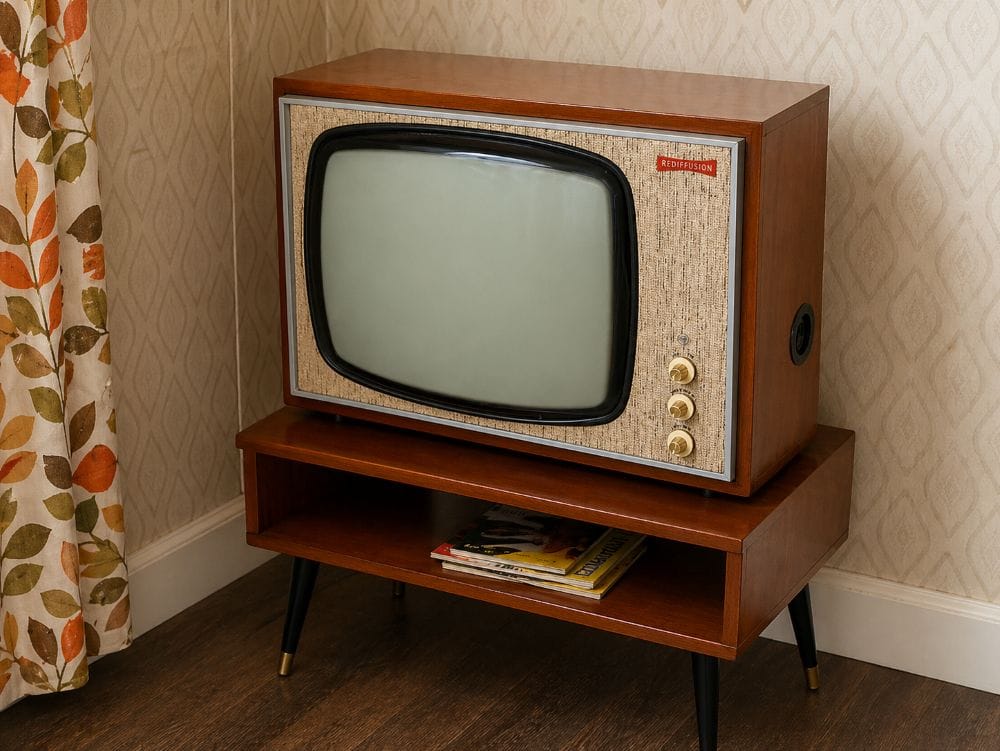
It wasn’t even self-contained in the way we’d think of today. The channel selector lived separately, mounted on the nearby window frame.
At the time, I had no idea that what we had was an early cable television system, rented from a company called Rediffusion. To me, it was just how television worked.
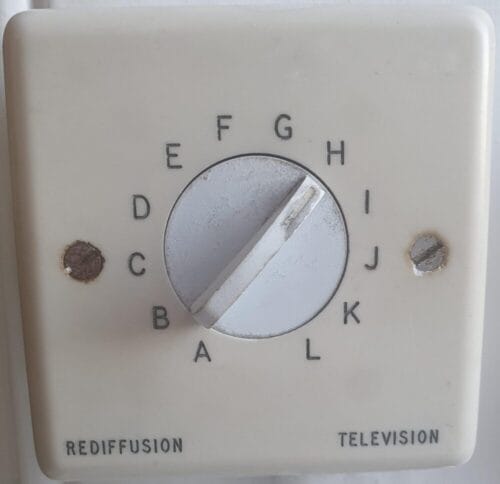
The selector itself was a rotary dial marked with letters rather than channel numbers. As I remember it, A, B, and C corresponded to BBC One, BBC Two, and ITV. The remaining letters switched over to radio—BBC Radio 1, 2, 3, 4, and possibly a local station. It felt oddly magical, even if I didn’t quite understand it.
What fascinated me most was how the system was connected. The television was effectively tethered to this selector box, yet even if the TV was switched off—or even unplugged—you could still hear radio, or even a TV channel, through the set’s speaker. As a child, that seemed almost impossible.
I remember asking whether it might be possible to have a television that you could simply move into another room, plug in, and have it “find” the channels wherever it was. I didn’t realise it then, but in my own way I was imagining broadcast television—signals travelling through the air to an aerial, rather than down a wire.
Most of our viewing happened in the evenings. Back then, television didn’t run all day, so it felt more like an event than a constant presence. We would gather as a family—sometimes I’d sit on the floor, sometimes on my mother’s knee—to watch the news and whatever programmes followed. It was shared, deliberate, and somehow more special because of it.
I must have watched children’s programmes after school, before my father claimed the set to watch the evening news. That short window of time felt like it belonged entirely to me.
In those days, children’s television wasn’t endless—it was a small, carefully scheduled part of the day, which somehow made it feel more special. I remember programmes like Blue Peter, which always seemed full of practical makes, badges, and a sense that you ought to be doing something useful with your hands. Then there was puppets were everywhere. Sooty and Sweep caused chaos in their own quiet way, while The Magic Roundabout had a charm that was oddly hypnotic, even if, as a child, I didn’t always understand what was going on.
There were also the slightly more adventurous programmes. Doctor Who, then there was Thunderbirds—all rockets, explosions, and heroic rescues—which felt like a glimpse into a very futuristic world.
As the afternoon slipped into evening, the tone would change. Children’s programmes would end, and the television would quietly become my father’s domain. The news would come on, and with it a sense that the day was settling down. What had been a source of imagination and escapism just moments before became something more serious, more grown-up.
Looking back, that daily handover—from children’s programmes to the evening news—felt like a small but regular reminder of how the television belonged to the whole family, but never entirely to any one of us.
Music was another part of our household technology, though at the time it felt just as mysterious as the television. We had a record player in the house—no doubt my father’s, I remember it most at parties. Singles would be stacked high on the tall centre spindle, one on top of another, waiting their turn. I was fascinated by the mechanism—the way each record would drop down in turn, perfectly timed, as the one before it finished. There was something almost magical about that moment when the next song began without anyone touching a thing.
There were albums too, and even a few old 78s, though I can’t clearly remember what music was played. It was just always there in the background—part of the atmosphere rather than something I paid close attention to at the time.
Of course, curiosity got the better of me more than once. I distinctly remember getting into trouble for playing records at the wrong speeds, turning what should have been familiar voices into something strange and comical. Even worse, I would sometimes hold the spindle to slow the record down, completely unaware—or unconcerned—about the damage I might be doing.
Thinking about it now, that fascination with “what happens if…” didn’t stop there. I later did much the same thing with my brother’s cassette recorder, experimenting with the sound by interfering with the mechanics. It was probably annoying for everyone else, but for me it was all part of figuring out how these machines worked—by pushing them just a little further than I was supposed to.
I don’t know where he got it, but my brother had a cassette recorder in the late 1960s—something similar to the portable models you’d see around at the time. I can’t remember the exact make, It was likely one of those solid, no-frills machines aimed at younger users.
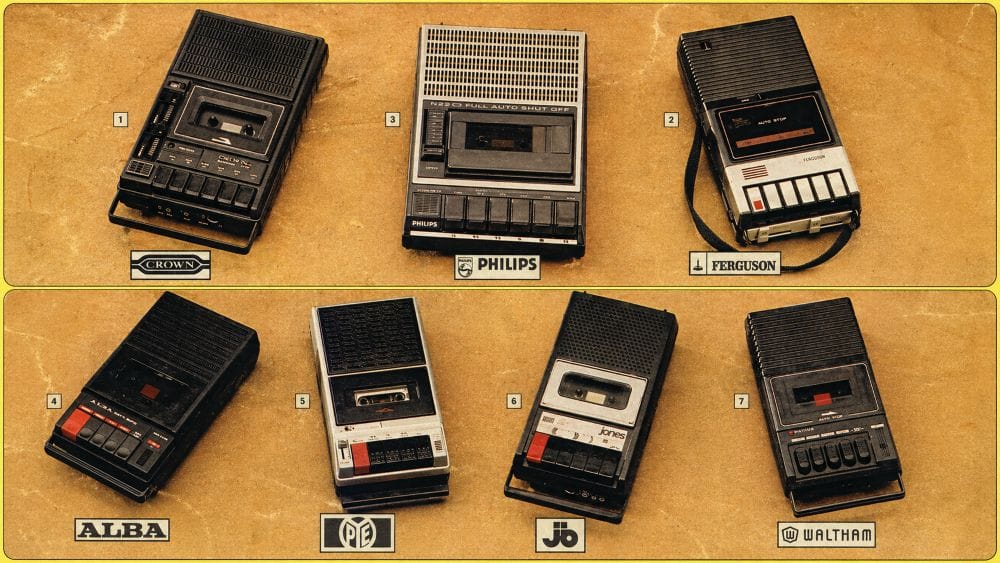
What I do remember clearly is that it had a microphone, which made it feel like a device full of possibilities.
My brother would often use it to record music straight from the television—usually from Top of the Pops—or from the radio, especially the weekly Top 40 countdown. Timing it right to avoid the presenter talking over the intro was almost an art form in itself.
When he let me use it, I took a slightly different approach. I became obsessed with recording the theme tunes from television programmes—both the ones I watched and, strangely, even some I didn’t. After a while, I had built up quite a collection, and I could recognise a show from just the first few seconds of music.
But more than anything, I loved experimenting. I would spend hours recording my own voice, then playing it back at different speeds. By gently holding the reels or interfering with the mechanism, I could slow the tape down or speed it up, turning my voice into something completely different. It probably wasn’t the best thing for the machine, but at the time it felt like discovering a kind of audio magic.
Looking back, it wasn’t just about the recordings themselves—it was about curiosity. That cassette recorder wasn’t just a way to capture sound; it was something to explore, to experiment with, and occasionally to push well beyond how it was meant to be used.
Thinking back, I probably didn’t watch all that much television during those years. Most of my time was spent outside, playing with friends until it got dark or I was called in. Television was there, but it wasn’t the centre of everything in the way it would become later.
When I did watch, though, there were certain programmes that really stuck with me. Shows like Doctor Who and Thunderbirds captured the imagination, while Tomorrow's World offered a glimpse of the future that felt both exciting and just out of reach. And of course, there was Top of the Pops, which tied in perfectly with the music we were trying to capture on cassette.
We also had the occasional American import, like Land of the Giants and Planet of the Apes, which somehow felt different—bigger, stranger, and a bit more exotic than what we were used to.
That said, television wasn’t really mine. My dad was in charge of the set, and what was watched—and when—was largely up to him. The only real opportunity I had to watch what I wanted was in that short window before he came home, or occasionally when he went out to the pub.
In a way, that made those moments more valuable. Television wasn’t something you could have whenever you liked—it was something you caught when you could. And perhaps because of that, the programmes I did see have stayed with me far more clearly than I might have expected.